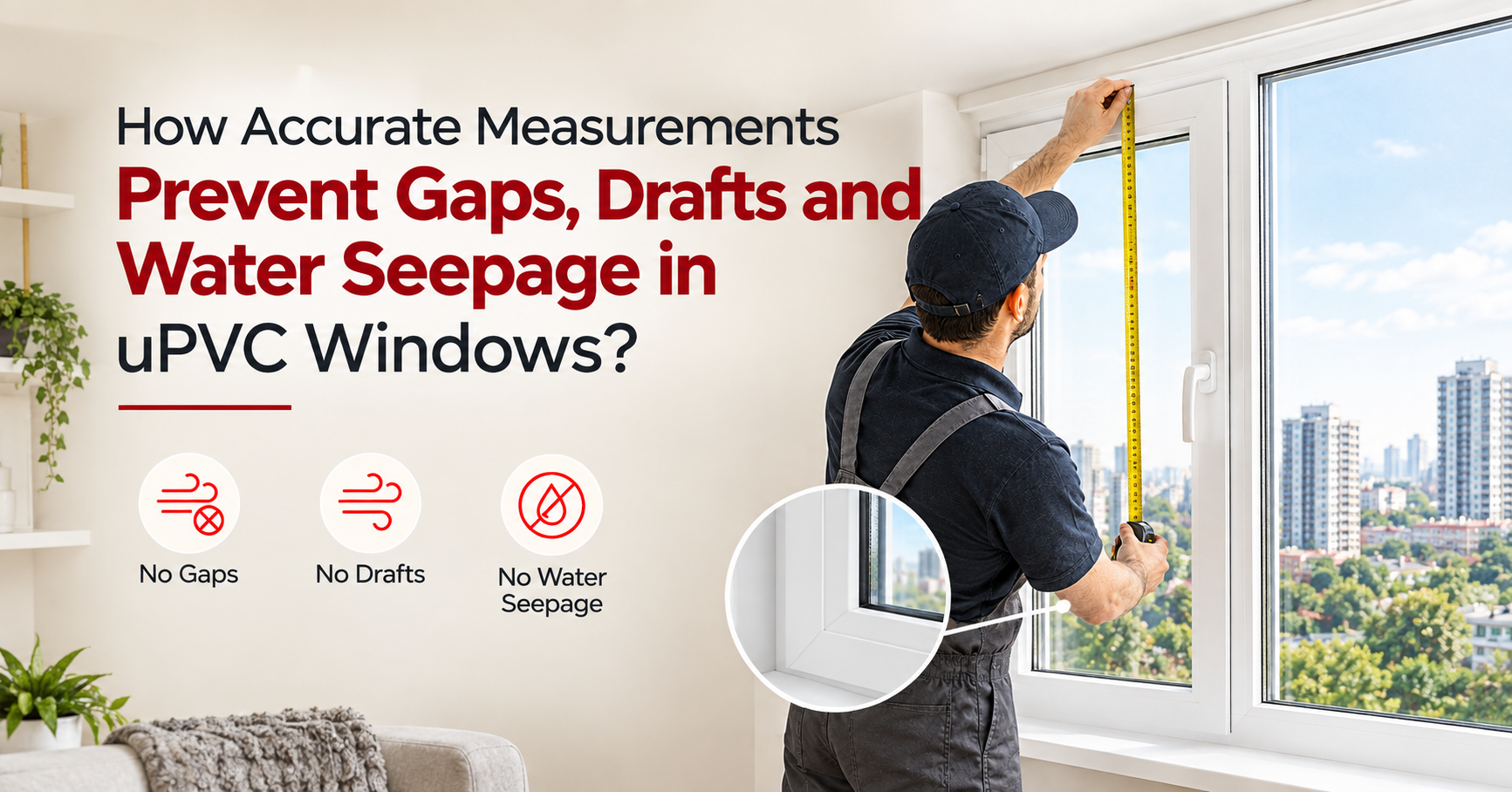
A uPVC window may look perfect after installation, but its long-term performance depends on something that happens before manufacturing even begins: accurate measurement of the opening.
A few millimetres of error can affect how a window frame sits inside the opening. If the frame is too small, excessive gaps may need to be filled and sealed. If it is too large, the frame may not sit correctly or may require unsuitable adjustments during installation.
These problems can eventually contribute to air drafts, dust entry, water seepage, poor operation and reduced insulation performance.
This is particularly important in places such as Mumbai, Navi Mumbai and other regions exposed to heavy rainfall, humidity, coastal air and strong seasonal weather.
For homeowners, architects, builders and project managers, understanding the relationship between measurement, manufacturing and installation can help avoid expensive problems later.
Why Accurate Measurements Matter for uPVC Windows?
A window opening is not always perfectly square, level or plumb. Walls can have minor variations because of construction tolerances, plastering, tiling and previous window installations.
Therefore, measuring only one width and one height is not always enough.
The objective is to determine the appropriate frame dimensions while allowing the installer to properly position, secure and seal the window.
Industry installation guidance specifically addresses rough-opening size, gap filling, shimming, sealants, flashing and anchorage because these details influence the performance of an installed window.
What Happens When uPVC Windows Are Measured Incorrectly?
Incorrect measurements can create problems at several stages.
Oversized Window Frames
If a manufactured window is larger than the available opening, the installer may struggle to position the frame correctly.
Forcing a frame into an unsuitable opening is not a substitute for correct measurement.
Excessive Gaps Around the Frame
If the window is manufactured significantly smaller than the opening, a larger perimeter gap can remain between the frame and wall.
Some installation clearance is necessary, but uncontrolled or excessive gaps need to be properly addressed.
Air-sealing guidance from the U.S. Department of Energy notes that gaps between window units and rough openings can become significant locations for uncontrolled air leakage.
Uneven or Difficult Installation
An opening that has not been measured properly can make it harder to position the frame accurately.
The issue is not necessarily the uPVC profile itself. It can be the relationship between the manufactured frame and the actual building opening.
How Accurate Measurements Help Prevent Drafts?
Drafts usually occur when unwanted air can move through gaps or joints.
A properly installed window should form an effective barrier between the indoor and outdoor environment. However, even a high-quality window can lose some of its intended performance if the perimeter connection to the wall is poorly executed.
The U.S. Department of Energy’s Building Science Education guidance recommends properly air-sealing the rough opening around windows and doors. It also notes that low-expansion foam designed for windows and doors, caulk or appropriate backer-rod systems can be used depending on the installation detail.
Measurement → Manufacturing → Installation
Think of the process as a chain:
Accurate measurement → Correct frame size → Proper positioning → Effective sealing → Better performance
If the first step is wrong, the following steps become more difficult.
This is why uPVC windows installation should not be treated as simply placing a finished window into a wall opening.
How Measurement Helps Reduce Water Seepage?
Water seepage around windows is one of the biggest concerns during heavy rainfall.
The window itself may be water-resistant, but the junction between the window and the building wall also needs to be properly designed and sealed.
Windows and doors interrupt the wall’s water-protection layer, which makes the perimeter around an opening particularly important. Building Science Education recommends properly integrated flashing and drainage strategies to direct water away from the opening rather than allowing it to enter the wall assembly.
Why This Matters in Mumbai?
Mumbai’s monsoon conditions make water management around windows especially important.
A window installation that looks fine during dry weather may reveal weaknesses during prolonged rainfall. Water can find its way through poorly sealed joints, unsuitable gaps or improperly detailed connections.
For this reason, homeowners searching for uPVC windows Mumbai should evaluate not only the window profile and glass but also the quality of measurement and installation.
The Correct Measurement Process for uPVC Windows
Professional measurement should be systematic rather than based on a single reading.
Why Installation Clearance Is Important?
A common misconception is that the window should fit the opening as tightly as possible.
In practice, the frame needs an appropriate installation gap or clearance based on the manufacturer’s system and the actual opening conditions.
The correct clearance is not a universal number for every uPVC window. It depends on the profile system, window dimensions, opening conditions and manufacturer’s installation instructions.
That is why measurements should be passed to the manufacturer or fabricator together with relevant site information rather than simply ordering a window based on approximate dimensions.
Accurate Measurements Are Especially Important for uPVC Sliding Windows
uPVC sliding windows are popular because they offer practical operation and are suitable for many residential and commercial applications.
However, sliding systems depend on proper frame alignment.
If the frame is not correctly positioned, problems may become noticeable during everyday use.
For sliding windows, measurement and installation should therefore consider not only the overall opening size but also the finished position and alignment of the complete system.
Ramkrishna uPVC lists uPVC sliding windows among its product range, alongside casement, combination, fixed, bay and other window solutions.
Measurement vs Installation: What Causes Gaps, Drafts and Leaks?
It is useful to understand that measurement and installation are connected but not identical.
This is why choosing suppliers of uPVC windows and doors should involve more than comparing profile prices.
Ask about the complete process:
Site measurement → Design → Manufacturing → Quality checks → Delivery → Installation → Final inspection
How Professional uPVC Manufacturers Improve Measurement Accuracy?
A manufacturer with a structured production process can connect site measurements with fabrication more effectively.
Ramkrishna uPVC states that its Vasai manufacturing facility uses automated German-engineered machinery, along with cutting, welding and CNC equipment. The company also highlights quality checks for strength, fit and finish.
This matters because precision at the manufacturing stage needs to complement precision at the site.
The company’s product range includes uPVC sliding windows, casement windows, fixed windows, combination windows, bay windows and specialized systems, allowing solutions to be selected according to the project.
Why You Should Not Rely on DIY Measurements Alone?
Measuring a window opening may appear simple, but converting those measurements into the correct manufactured frame size requires technical judgment.
A homeowner may measure:
“Width: 1200 mm, Height: 1500 mm.”
But a professional needs to consider what those dimensions represent and how the actual opening behaves across multiple points.
For replacement projects, the situation can be even more complicated because existing aluminium, wooden or other frames may affect the available opening.
Professional measurement helps connect site conditions with the final window design.
Choosing the Right uPVC Window Supplier
When comparing suppliers of uPVC windows and doors, do not evaluate suppliers based only on the lowest quotation.
Consider:
Manufacturing Capability
Ask whether the supplier manufactures the windows or primarily resells finished products.
Measurement Process
Find out whether trained personnel visit the site for measurement.
Product Selection
Look for a supplier offering different window and door configurations so the product can be matched to the application.
Installation Support
A quality product needs appropriate installation to achieve its intended performance.
Quality Control
Ask how frames, welding, hardware, glass and finished products are checked before delivery.
After-Sales Support
Clarify what happens if adjustment, service or inspection is required after installation.
Ramkrishna uPVC presents itself as a manufacturer and supplier with a manufacturing facility in Vasai and an office in Seawoods, Navi Mumbai, serving residential, commercial and other applications.
Can Accurate Measurements Eliminate Water Leakage Completely?
No.
Accurate measurement reduces installation-related risks, but it cannot guarantee that a window will never experience leakage.
Installed windows can be evaluated for water penetration using recognized test methods. ASTM E1105, for example, covers field testing of installed exterior windows, doors and similar assemblies for water penetration under controlled conditions.
The important takeaway is that measurement is the foundation, not the entire solution.
The Complete Formula for Better uPVC Window Performance
A successful window installation can be viewed as a chain:
- Measure Correctly
Understand the actual opening rather than relying on assumptions.
- Design Appropriately
Select the right window configuration, glass and hardware for the application.
- Manufacture Precisely
Convert site dimensions into accurately fabricated frames.
- Prepare the Opening
Ensure the opening is suitable, clean, aligned and ready for installation.
- Install Correctly
Position, fix, shim and align the frame according to the system requirements.
- Seal and Weatherproof
Create appropriate air and moisture control around the perimeter.
- Inspect Before Handover
Check operation, alignment, seals, drainage and finishing.
This approach is much more reliable than treating window installation as a single task
How accurate should uPVC window measurements be?
Measurements should be taken carefully at multiple points and recorded according to the manufacturer’s system and installation requirements. The final frame dimensions should account for appropriate installation clearance rather than simply matching the opening dimensions.
Can incorrect window measurements cause water seepage?
Yes. Incorrect dimensions can contribute to unsuitable gaps or poor frame positioning. However, water seepage can also result from inadequate sealing, drainage, flashing, wall conditions or installation workmanship.
Why are uPVC sliding windows sensitive to accurate installation?
Sliding windows rely on correct frame alignment for smooth operation and effective sealing. An incorrectly positioned or distorted frame can affect how the sliding panels and seals perform.
Should I measure my window before contacting a uPVC supplier?
You can take approximate dimensions for an initial quotation, but professional site measurement is preferable before manufacturing. This helps account for variations in the actual opening.
Does a smaller gap around the window always mean a better installation?
No. The frame needs appropriate installation clearance based on the window system and site conditions. The objective is not to eliminate the installation gap but to control and seal it correctly.
What should I check before uPVC windows installation?
Check the opening dimensions, level, plumb, sill condition, frame size, installation clearance, fixing method, sealing details and drainage provisions.
Are uPVC windows suitable for Mumbai's climate?
uPVC windows can be suitable for Mumbai’s humid and rainy environment, but performance depends on the selected system, glass, hardware, installation quality and weatherproofing. Ramkrishna uPVC specifically markets its products for Indian climatic conditions and offers uPVC window systems for Mumbai and Navi Mumbai projects.
How do I choose a uPVC window manufacturer in Mumbai?
Look for a manufacturer that offers professional measurement, controlled manufacturing, quality checks, suitable product options and installation support. Do not compare suppliers on price alone.
Final Takeaway: Measure First, Install Right
The performance of a uPVC window begins long before the frame reaches your home.
Accurate measurement helps create the right foundation for manufacturing, installation, sealing and drainage. When measurements are inaccurate, even a high-quality window can face avoidable installation challenges.
For homeowners considering uPVC windows Mumbai, the best approach is to evaluate the entire process rather than focusing only on the window price.
From site measurement and customized manufacturing to installation and finishing, every stage contributes to the final result.
If you are planning a residential, commercial or renovation project, working with an experienced uPVC windows and doors manufacturer and supplier can help you select the right configuration and ensure that the installation is based on actual site conditions.
For customized uPVC windows and doors, you can explore Ramkrishna uPVC’s window and door solutions and discuss your project requirements with their team.