Choosing new windows and doors is rarely just about finding the lowest quotation. A cheaper window can become an expensive decision if it uses unsuitable profiles, weak hardware, poor glazing or improper installation.
For homeowners, builders and commercial property owners, the better approach is to compare overall value rather than only the initial price. A reliable manufacturer should provide the right combination of material quality, design, performance, installation and after-sales support.
If you are comparing uPVC windows and doors, here are the key factors to check before placing an order.
1. Look at the Manufacturer, Not Just the Dealer
The first question to ask is whether you are dealing directly with a manufacturer or only a reseller.
A manufacturer with its own production facility may have greater control over fabrication, dimensions, welding, quality checks and customization. It can also make communication easier when your project involves non-standard sizes or multiple window styles.
For example, Ramkrishna uPVC operates a manufacturing facility in Vasai and states that it uses automated production equipment, cutting, welding and CNC machinery as part of its manufacturing process.
Ask these questions before requesting a quotation:
- Where are the windows manufactured?
- Can I visit the manufacturing facility or showroom?
- What profile system is being used?
- Is reinforcement included where required?
- Who will take the final measurements?
- Who is responsible for installation?
- What after-sales support is provided?
These questions can reveal more about a supplier than a promotional brochure.
2. Compare the Complete Specification, Not Just the Price
Two quotations can look similar while specifying very different products.
When comparing uPVC windows and doors, ask each supplier to provide a detailed specification covering:
- uPVC profile type and dimensions
- Number of chambers, where applicable
- Reinforcement specifications
- Glass thickness and type
- Single or double glazing
- Hardware and locking system
- Gaskets and sealing components
- Window or door configuration
- Installation materials
- Transportation
- Removal of existing windows, if required
- Taxes and other charges
- Warranty terms
A quote of ₹X from one manufacturer cannot be fairly compared with ₹Y from another unless both are offering broadly comparable specifications.
3. Check the Quality of the uPVC Profiles
The profile is one of the most important components of a uPVC window or door. A good-looking finished window does not automatically mean the underlying profile meets the required quality parameters.
India has IS 17953:2023, which specifies requirements for uPVC profiles used for windows and doors. BIS documentation covers characteristics such as dimensions, structural properties, impact strength, weathering-related performance and other profile requirements.
Therefore, instead of simply asking whether a manufacturer offers “premium” profiles, ask for specific technical information and applicable compliance documentation.
A useful checklist includes:
- Profile specification
- Wall thickness
- Reinforcement details
- UV/weathering considerations
- Profile consistency
- Applicable standards or certifications
- Glass compatibility
- Fabrication quality
A transparent uPVC door window manufacturer should be able to explain what is being supplied rather than relying only on generic quality claims.
4. Don't Ignore Glass and Hardware
The frame is only one part of the finished window.
The glass, hardware, locking system, gaskets and installation can significantly affect how the completed unit performs.
For example, if noise reduction is a priority, simply selecting a uPVC frame is not enough. Glass configuration, air gaps, sealing and installation all influence acoustic performance.
Similarly, thermal performance depends on the complete window system rather than the frame material alone. Factors such as glazing type and solar heat gain can affect the amount of heat entering or leaving a building.
Ask the manufacturer to explain why a particular glass and hardware combination has been recommended for your property.
5. Choose the Window Style According to the Opening
You don’t necessarily need the same type of window throughout your property.
Depending on the opening and intended use, options can include:
- Sliding windows for spaces where outward clearance is limited
- Casement windows where a different opening configuration is preferred
- Fixed windows where ventilation is not required
- Combination windows for larger or customised openings
- Glass-to-glass designs where maximising the visual opening is important
Ramkrishna uPVC lists sliding, casement, fixed, combination, bay, glass-to-glass and other specialised window solutions.
A good manufacturer should recommend the configuration based on the opening, ventilation requirements, building design and budget rather than simply selling the most expensive option.
6. Don't Overpay for Features You Don't Need
Saving money does not always mean choosing the cheapest specification. It can also mean avoiding unnecessary upgrades.
For example, if a room does not need an opening window, a fixed configuration may be worth considering. If a particular room has no significant noise issue, you may not need the same acoustic specification throughout the property.
7. Compare Long-Term Cost, Not Just Purchase Price
The cheapest quotation is not necessarily the lowest-cost option over the life of the installation.
Consider:
Total value = Initial cost + maintenance + repairs + replacement risk + operating considerations
uPVC is generally valued for its low-maintenance characteristics, and Ramkrishna uPVC highlights resistance to corrosion, weather exposure and routine maintenance requirements among its product benefits.
For energy-conscious projects, also ask the manufacturer about the glazing and thermal characteristics of the complete window. Energy performance varies according to factors such as climate, glazing and solar heat gain, so specifications should be selected for the actual building rather than assumed from the frame material alone.
8. Check After-Sales Support Before You Buy
Windows and doors are long-term installations. Ask what happens if:
- A handle needs adjustment
- A locking mechanism requires service
- A glass unit needs replacement
- A gasket needs attention
- A window develops an operational issue
A dependable uPVC window manufacturer should clearly explain its warranty, service process and responsibilities after installation.
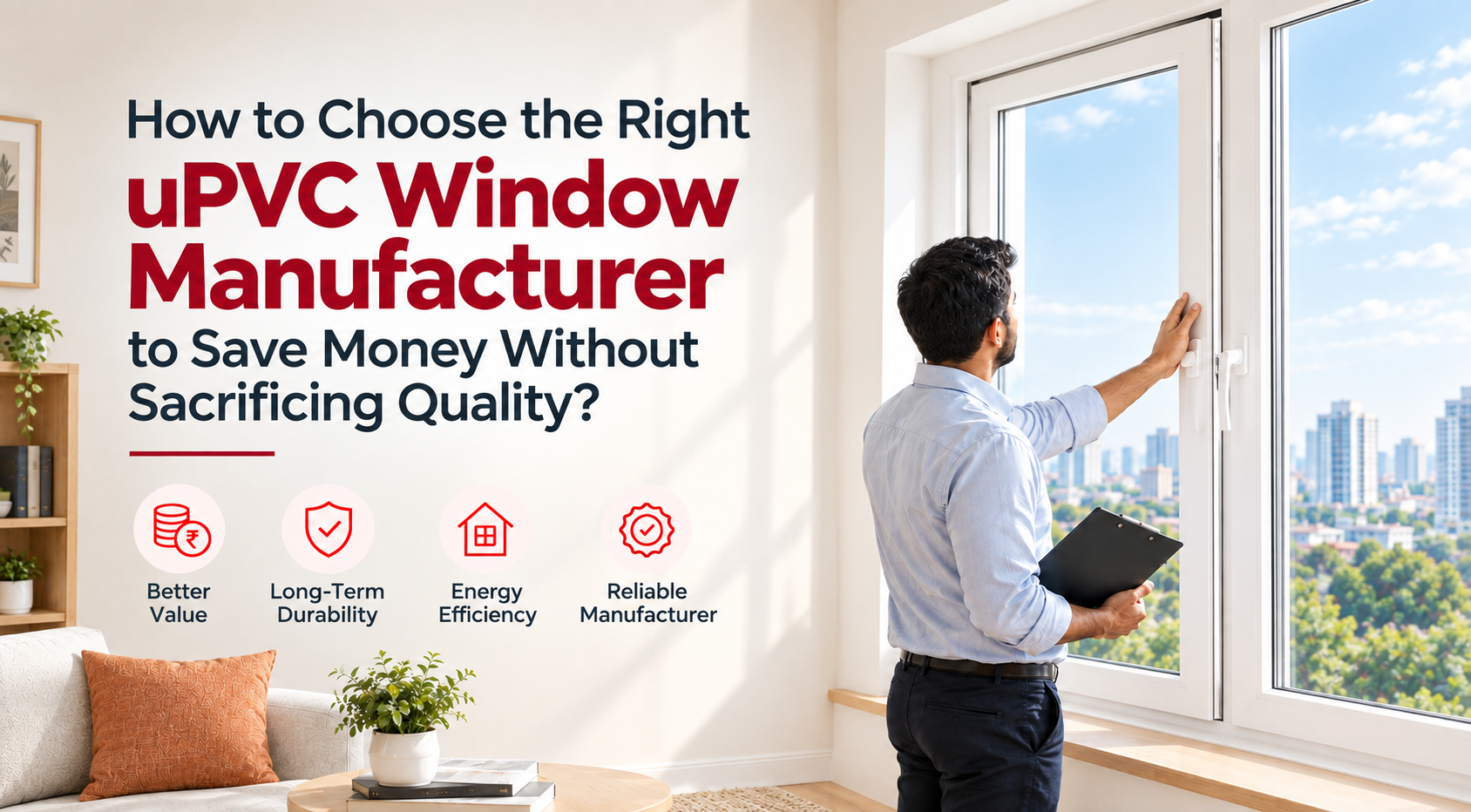
Choosing the right manufacturer is one of the easiest ways to protect your window investment. Instead of comparing quotations based only on the final number, compare profiles, glass, hardware, fabrication, installation, warranty and service.
The right uPVC windows and doors should match your property’s functional requirements as well as your budget. A manufacturer that provides transparent specifications and professional guidance can help you avoid unnecessary upgrades while ensuring that essential quality is not compromised.
If you are planning a residential, commercial or renovation project in Mumbai or Navi Mumbai, Ramkrishna uPVC offers customised window and door solutions, with manufacturing facilities in Vasai and an office in Seawoods, Navi Mumbai.